
Choosing between OEM replacement cone crusher parts and custom-engineered alternatives isn’t really a question of trust. It’s a question of fit, and fit depends entirely on your specific application, your ore characteristics, your production targets, and what you actually need the parts to do.
Both options have legitimate value. The goal of this article isn’t to declare a winner. It’s to give maintenance leads, operations managers, and purchasing teams a clear framework for making the right call for their specific situation.
What OEM Replacement Cone Crusher Parts Actually Include
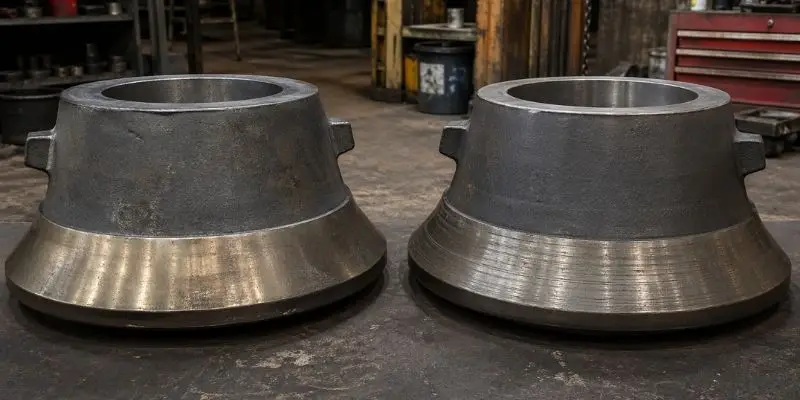
OEM parts are designed and manufactured by the original equipment manufacturer to match the specifications of their machine exactly. For cone crusher components, that means fit, form, and function compatibility is guaranteed out of the box. You know the part will seat correctly, meet the design tolerances the machine was built around, and perform within the parameters the OEM intended.
That certainty has real value, especially for complex mechanical components where dimensional tolerance is critical and where a mismatch could cause serious downstream damage. OEM replacement cone crusher parts also come with the backing of the manufacturer’s engineering team and warranty support, which matters to purchasing managers managing supplier risk.
The tradeoff is that OEM parts are designed for average conditions across a wide range of applications. They’re not optimized for your ore body, your feed gradation, or the specific performance gaps your operation is trying to close. They’re built to work correctly, not necessarily to work best for you.
Where Custom-Engineered Alternatives Fit In
Custom-engineered crusher parts, when they’re done properly, start from the same engineering foundation as OEM parts but go further. A genuinely engineered alternative isn’t just a copy of the OEM part made from a different alloy. It’s a part that’s been designed or redesigned with your specific application in mind, using knowledge of how the full machine system works and where the original design has room for improvement.
For custom engineered crusher liners specifically, that means analyzing your feed gradation, ore hardness, reduction ratio requirements, and wear history to develop a liner profile and alloy combination that’s optimized for your site rather than for the average application. The result is often longer wear life, better throughput, and more consistent product size compared to running a standard OEM liner spec.
The key word is “properly.” Not every aftermarket supplier is doing genuine engineering work. Some are simply casting copies of OEM parts with marginal material changes and calling them engineered solutions. The distinction matters enormously, and we’ll come back to it.
The Cases Where OEM Makes Sense and Where It Doesn’t
OEM replacement cone crusher parts tend to make the most sense when:
- You’re dealing with a complex mechanical component where dimensional precision is critical and the consequences of a mismatch are severe
- You’re in a region or situation where delivery speed from the OEM is faster than an aftermarket alternative
- The component in question hasn’t shown any performance gaps that would justify an engineering review
Custom-engineered alternatives tend to deliver better value when:
- Your liner life is consistently shorter than expected and alloy or profile optimization could extend it
- Your throughput isn’t meeting targets despite correct operating parameters
- You’re seeing wear patterns that suggest the OEM liner profile isn’t well matched to your feed
- You need engineering support and ongoing optimization, not just a parts transaction
For most large mining operations, the right answer isn’t one or the other across the board. It’s OEM for certain components and engineered alternatives for the ones where site-specific optimization creates measurable performance gains.
What Separates a Quality Aftermarket Supplier From a Parts Reseller
This is the question that matters most when evaluating a move away from OEM replacement cone crusher parts for any component. A genuine engineering partner brings a few things a parts reseller can’t:
- In-house engineers who understand how the full cone crusher system works, not just the individual part
- The ability to analyze your wear data, feed conditions, and production history before recommending a solution
- On-site support capability when something needs to be evaluated in the field
- A track record of documented performance improvements across comparable applications
If a supplier can’t walk you through the engineering rationale behind their part design in specific terms, they’re probably not doing genuine engineering work. That distinction is worth pressing on before you make a switch.
Why the OEM vs. Aftermarket Debate Misses the Real Question
The framing of OEM versus aftermarket keeps teams focused on supplier category when they should be focused on performance outcomes. The better question isn’t “should we use OEM or aftermarket?” It’s “is our current liner design, regardless of source, optimized for our specific application?”
We’ve seen sites running custom engineered crusher liners that were no better than what they replaced because the engineering wasn’t site-specific. We’ve also seen sites running OEM liners that were significantly underperforming because the standard profile was never right for their feed in the first place. Supplier category doesn’t determine outcome. Engineering quality and application fit do.
The mines that get the most out of their cone crusher parts, whether OEM or custom-engineered, are the ones asking their supplier to prove fit rather than assuming it.
Making the Right Call for Your Operation
The decision between OEM replacement cone crusher parts and custom-engineered alternatives comes down to two questions: Is the current part performing the way you need it to? And does your supplier have the engineering capability to improve it if it isn’t?
If the answer to both questions is yes with your current OEM supplier, there’s no compelling reason to switch for that component. If the answer to either question is no, a conversation with an engineering-led aftermarket partner is worth having.
Optimum Crush works through exactly this kind of evaluation with mining teams regularly. If you’re not sure whether your current parts are optimized for your application, reach out and let’s take a look at the data together.
FAQ
Are aftermarket cone crusher parts as reliable as OEM parts? It depends entirely on the supplier. A genuinely engineered aftermarket part from a supplier with in-house crusher engineering capability and a documented quality process can match or exceed OEM reliability. A copy part from a reseller without real engineering backing often can’t. The distinction is in the engineering process and the supplier’s ability to demonstrate application fit, not in the aftermarket category itself.
Will using aftermarket cone crusher parts void my OEM warranty? Warranty implications vary by OEM and by contract. It’s worth reviewing your specific OEM agreement before making any parts substitutions on components that are still under warranty coverage. For machines that are past their warranty period, aftermarket parts typically carry no warranty risk from the OEM side.
What should I ask an aftermarket supplier before switching from OEM parts? Ask them to walk you through the engineering rationale behind their part design for your specific application. Ask for documented performance data from comparable sites. Ask whether they have in-house engineers who can support you on-site if something needs to be evaluated in the field. A supplier who can answer those questions specifically and credibly is doing genuine engineering work. One who can’t probably isn’t.
How do custom engineered crusher liners differ from standard OEM liners? Standard OEM liners are designed to perform correctly across a wide range of applications. Custom engineered crusher liners are designed specifically for your feed gradation, ore hardness, reduction ratio requirements, and wear history. The profile geometry and alloy selection are both optimized for your site rather than for average conditions, which typically results in longer wear life, better throughput consistency, and more predictable liner intervals.
 English
  Spanish
  French