

Wear problems on cone crusher liners don’t appear fully formed. They develop gradually, and the gap between when they start and when they become visible to the naked eye is where the most valuable maintenance interventions live and where most teams aren’t looking.
Crusher liner wear analysis is the systematic process that closes that gap. It converts wear observation from a passive activity, noting that the liner looks worn at change time, into an active diagnostic process that identifies developing problems while they’re still in the stage where a planned intervention can address them. For mining operations where the cost of unplanned downtime is significant and where planned maintenance windows are finite and valuable, that early identification capability is worth building deliberately rather than leaving to chance.
Get your free liner analysis →
Why Early Wear Problem Identification Changes the Maintenance Equation
The maintenance equation for a wear problem changes fundamentally depending on when it’s identified. Identified early, a developing wear problem is a scheduled maintenance decision: what to do about it, when to do it, and what components to have ready. Identified late, the same problem is an emergency response: stopping the machine, finding the parts, and executing under time pressure with production stopped and the clock running.
Those two scenarios have very different cost profiles. The early identification scenario costs planned downtime and the parts required for the intervention. The late identification scenario costs unplanned downtime, often at a premium because the maintenance window wasn’t scheduled and the team wasn’t prepared, plus the secondary damage that frequently occurs when a wear problem progresses to failure before it’s addressed.
The difference between them is almost entirely determined by whether the maintenance team has the process and the knowledge to identify developing wear problems before they cross the threshold into the failure zone. Crusher liner wear analysis is what builds that process and knowledge systematically rather than relying on individual experience and observation that varies across team members and shifts.
The Difference Between Monitoring Wear and Reading It
Most mining operations monitor wear in some form. They track liner change intervals, observe liner condition during operation, and conduct visual inspections at scheduled maintenance windows. That monitoring activity produces awareness of wear without producing understanding of it, and the gap between awareness and understanding is where early problem identification lives.
Reading wear rather than just monitoring it means extracting the diagnostic information that wear patterns, wear rates, and wear distribution contain about what’s actually happening in the crushing chamber. A liner that’s wearing faster than expected isn’t just a wear problem. It’s a symptom of a specific cause, whether that’s a feed condition issue, a CSS management problem, a liner profile mismatch, or an alloy condition that’s not suited to the current ore characteristics. Identifying the cause rather than just the symptom is what makes the intervention effective rather than just reactive.
Crusher liner wear analysis that reads wear rather than just monitoring it produces three outputs that monitoring alone doesn’t. It identifies the specific cause of the wear pattern being observed. It projects how the wear will progress if the cause isn’t addressed, which allows the timing of the intervention to be planned rather than forced. And it informs the next liner selection decision based on what the current liner’s wear behavior has revealed about the operating conditions it encountered.
Early Warning Indicators of Developing Wear Problems
Wear Rate Acceleration Between Measurement Intervals
The most reliable early indicator of a developing wear problem is an increase in wear rate between consecutive measurement intervals that can’t be explained by a change in operating conditions. A liner that was consuming two millimeters per week for its first four weeks and is now consuming three millimeters per week in week five, under the same feed conditions and CSS, is telling you that something has changed in how the chamber is loading the liner. That acceleration almost always continues and typically steepens rather than stabilizing, which is why catching it at the first measurement that shows it is significantly more valuable than waiting for the next one to confirm it.
Wear Concentration Migrating Toward a Single Zone
Even wear distribution across the full liner height is the target condition. Wear that’s progressively concentrating in a narrowing zone as the liner ages indicates that the chamber geometry is changing in a way that’s focusing loading rather than distributing it. That concentration pattern accelerates as it develops: the concentrated zone wears faster, which changes the profile geometry further, which concentrates the loading more, which accelerates the wear in that zone further. Catching the concentration at its early stage, before the feedback loop has had multiple measurement intervals to develop, is what makes the intervention effective.
Asymmetric Circumferential Wear Developing Mid-Cycle
Wear that develops asymmetrically around the liner’s circumference during the liner’s operating cycle rather than being present from the first measurement indicates that a feed distribution condition has changed since the liner was installed. A liner that showed even circumferential wear at the first measurement and uneven circumferential wear at the second is telling you that something about how material is entering or distributing in the chamber has changed between those two measurement points. Feed system changes, conveyor wear that’s affecting material trajectory, or changes in the blend of ore zones being processed are the most common causes.
Power Draw Trending Up Without Corresponding Throughput Increase
Power draw that trends upward across consecutive shifts without a corresponding increase in throughput or feed rate indicates that the chamber is working harder to produce the same output. In the context of liner wear analysis, this pattern typically means the liner profile has worn past the geometry that efficiently converts energy into breakage, and the machine is compensating with additional power to maintain throughput. Catching this pattern early, before the efficiency loss becomes severe, allows a CSS adjustment or an early liner change decision to recover performance before it affects production targets materially.
Product Size Coarsening Trend at Stable CSS
A gradual trend toward coarser product output at a CSS that hasn’t changed indicates that the liner’s effective geometry is changing in a way that CSS measurement alone doesn’t capture. As a liner wears unevenly, the actual crushing geometry at different points around the chamber circumference diverges from the measured CSS, producing a product that’s coarser than the CSS setting would suggest. Tracking product gradation alongside CSS across the liner’s operating life reveals this trend early enough to inform a proactive CSS adjustment or early replacement decision rather than discovering it when product quality has already affected downstream processing.
How to Build a Systematic Early Wear Detection Process
A systematic early wear detection process has four components that work together to convert wear observation into actionable diagnostic information on a consistent basis.
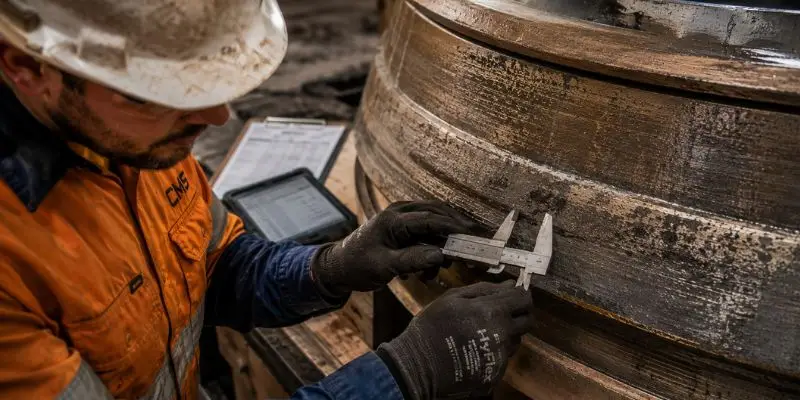
Standardized measurement protocols define exactly where wear is measured on the liner, how it’s measured, and what’s recorded at each measurement point. Without standardization, measurements taken by different team members at different points across the liner height aren’t comparable, and the trend data that makes early detection possible can’t be built from inconsistent inputs. The protocol should specify a minimum of four measurement points across the liner height and at least two circumferential positions at each height to capture both vertical wear progression and circumferential wear distribution.
Regular measurement intervals that are calibrated to the liner’s wear rate rather than to a fixed schedule ensure that the measurement frequency is high enough to catch acceleration before it progresses too far between intervals. A liner consuming two millimeters per week needs more frequent measurement than one consuming half a millimeter per week to catch a fifty percent acceleration before it becomes a severe concentration problem.
Trend tracking that compares each measurement against the previous measurement and against the expected wear curve built from the liner’s early measurements allows deviations from expected progression to be identified rather than just absolute wear values to be recorded. A measurement that shows the liner is at forty percent of total thickness consumed is less useful than a measurement that shows the liner is at forty percent consumed and the wear rate has accelerated by thirty percent in the last two weeks.
Engineering review of measurement data at defined intervals connects the wear data to decisions rather than allowing it to accumulate without being acted on. Wear data that’s collected consistently but reviewed only at liner change time misses the early intervention window that the data was collected to identify. A brief engineering review of wear trend data every two to three weeks, either internally or with an engineering support partner, is what ensures the data drives decisions rather than just documenting outcomes.
The Wear Problem Category That Hides Best Until It’s Too Late
Here’s the wear problem type that consistent crusher liner wear analysis catches and that observation-only monitoring almost always misses until it’s caused a more expensive problem: sub-surface wear that affects liner structural integrity before it’s visible on the surface.
Some ore types, particularly those with high impact characteristics alongside abrasive properties, create a wear mode where the liner material is being stressed and micro-fractured beneath the surface while the surface itself still appears serviceable. The surface wear rate looks normal. The liner looks fine. Underneath, the material is developing a network of micro-fractures that progressively reduce its structural integrity until a section of the surface spalls or fractures under load.
That failure mode is invisible to visual inspection and doesn’t show up clearly in standard wear depth measurements because the surface is still there. It does show up in a few subtle indicators: a change in the sound the liner makes when tapped with a hammer inspection, a slight change in surface texture in affected zones that experienced inspectors can feel rather than see, and in advanced cases a slight bulging or deformation of the surface that precision measurement detects before it’s visible.
Catching this wear mode requires adding a basic tap test to the regular wear measurement protocol and training the team to feel for surface texture changes alongside measuring depth. It’s a small addition to the inspection process that catches a failure mode that causes some of the most dramatic and unexpected liner failures in high-impact ore applications. Good cone crusher maintenance practice in high-impact environments includes this check as a standard element rather than an occasional addition.
Translating Early Wear Detection Into Proactive Maintenance Action
Early wear detection only delivers its full value when the findings it produces drive timely maintenance decisions rather than being documented and filed. Translating wear detection into maintenance action requires a clear decision framework that connects specific findings to specific responses.
Wear rate acceleration above a defined threshold triggers a CSS review and a supplier notification that a liner change may be needed earlier than the scheduled date. That notification gives the supplier time to confirm parts availability and adjust delivery timing if needed, which is exactly the kind of lead time advantage that early detection creates.
Wear concentration developing in a specific zone triggers an assessment of the feed conditions and CSS management that have been present since the last measurement showing even distribution. The goal is to identify whether an operating condition change caused the concentration and whether correcting that condition will slow the concentration’s development, or whether the liner profile needs to be addressed at the next change.
Power draw trending up alongside wear measurements approaching the replacement threshold triggers a proactive replacement scheduling decision rather than waiting for the power draw to affect throughput materially. The combination of the two signals provides confidence that the replacement timing is right rather than premature.
Crusher liner wear analysis that’s connected to this kind of decision framework isn’t just a measurement activity. It’s the early warning system that keeps planned maintenance ahead of unplanned failures, and the mining operations that build it deliberately have a measurable advantage in how rarely their crushing circuits are controlled by events rather than decisions. If your team’s current wear detection process isn’t producing that quality of early warning, Optimum Crush’s engineering team can help you build a more systematic approach. Reach out and let’s talk about what a complete wear analysis process would look like for your operation.
 Spanish
  English
  French