



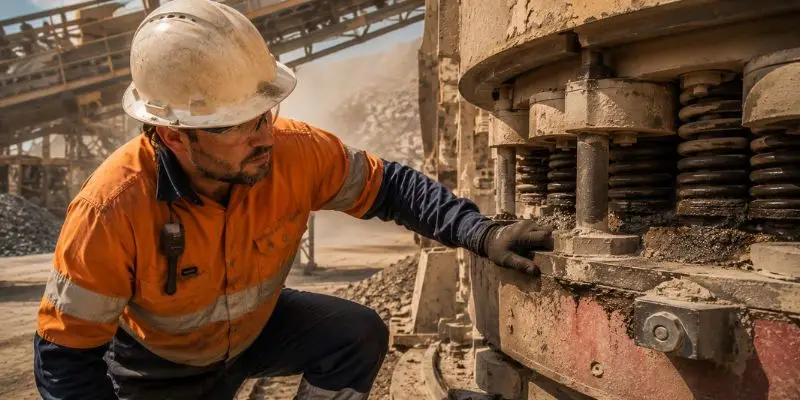
Cone crushers rarely fail without warning. What they do is give warnings that get misread, deferred, or absorbed into the background noise of normal operations until the warning becomes a failure. When you fall into cone crusher troubleshooting, there are five consistent signs that precede the most costly and most avoidable crusher inspection events, and recognizing them in time to act is what separates a planned intervention from an emergency shutdown.
Cone crusher troubleshooting begins with knowing which signals cross the threshold from “monitor and note” to “stop and inspect.” That threshold isn’t always obvious, and the pressure to keep production running creates a consistent bias toward deferral that the most consequential warning signs don’t deserve. This article identifies the five signs that warrant immediate inspection regardless of production pressure, what each sign indicates about what’s happening inside the machine, and what the right response looks like when you see one.
Why Warning Signs Deserve Immediate Attention Rather Than a Wait-and-See Approach
The wait-and-see response to crusher warning signs is understandable. Stopping a crusher for inspection during a production period has an immediate and visible cost: downtime, lost throughput, and the organizational pressure that comes with taking a machine offline when the production target is still running. The cost of not stopping for inspection is less visible until it isn’t, at which point it’s typically much larger.
The asymmetry between those two costs is what makes the wait-and-see response so expensive in practice. An inspection that finds nothing wrong costs a few hours of planned downtime. An inspection deferred until the warning sign escalates to a failure can cost days of unplanned downtime, secondary damage to components that were fine before the failure occurred, and repair costs that dwarf the production value of the hours the inspection would have consumed.
The five signs below are ones where the wait-and-see cost-benefit calculation consistently and significantly favors immediate inspection. They’re not signs that warrant monitoring while production continues. They’re signs that warrant stopping the machine and finding out what’s happening before continuing production creates a problem that a brief inspection would have prevented.
The 5 Signs Your Cone Crusher Needs Immediate Inspection
Sign 1: Sudden or Unexplained Change in Power Draw
A significant change in power draw that doesn’t correlate with a change in feed rate, feed gradation, or CSS setting is one of the most reliable indicators that something has changed inside the crusher. Power draw that spikes suddenly and then returns to normal suggests the machine encountered an unusual load event: possible tramp metal, a sudden feed surge, or a mechanical resistance that resolved itself temporarily. Power draw that increases gradually and then plateaus at a higher-than-normal level without a corresponding throughput increase suggests the chamber geometry has changed, which can indicate liner movement, backing material failure, or a mechanical condition that’s creating additional internal resistance.
Either pattern warrants an inspection before the next production shift. A single unexplained power event that resolved itself might be an isolated occurrence. A pattern of unexplained power events is almost always a symptom of a developing condition that the next shift’s production will continue to stress.
Sign 2: Unusual Noise or Vibration
When cone crusher troubleshootings, you have to know the characteristic sound signature under normal operating conditions that experienced operators learn to recognize. A change in that signature, whether a new noise, a change in pitch or rhythm, or a vibration that wasn’t present previously, is the machine communicating that something has changed in how it’s operating internally.
Metallic knocking or clanging suggests contact between components that shouldn’t be in contact, which can indicate liner looseness, backing material failure, or a mechanical clearance that has closed beyond its design range. A rhythmic noise tied to crusher rotation frequency suggests an eccentric or main shaft condition worth investigating. A continuous grinding sound that wasn’t present before a recent liner change may indicate improper liner seating or backing material that wasn’t mixed or applied correctly. Any of these warrants stopping the crusher for inspection rather than continuing to operate while the noise is investigated remotely.
Sign 3: Hydraulic System Pressure Anomalies
The cone crusher’s hydraulic system is a real-time reporter of what’s happening in the crushing chamber. Pressure relief events that are occurring more frequently than normal, pressure readings that are higher than typical for the current feed conditions and CSS setting, or hydraulic fluid that’s returning to the reservoir at elevated temperature all indicate that the crushing chamber is generating forces that the machine’s normal operating parameters don’t account for.
Frequent pressure relief events in particular deserve immediate attention. The relief system is working as designed when it responds to tramp metal or feed surges. When it’s cycling frequently under what appear to be normal feed conditions, the chamber is generating abnormal forces that the hydraulic system is absorbing. The source of those forces, whether a liner condition, a feed distribution problem, or a mechanical constraint, needs to be identified before continued operation compounds it.
Sign 4: Visible Oil Contamination or Unusual Fluid Condition
Oil that returns from the lubrication circuit with visible contamination, discoloration, elevated temperature, or particulate matter that wasn’t present in previous samples is one of the highest-consequence warning signs a cone crusher can produce. The lubrication system passes through the crusher’s bearing surfaces, and contamination in the returning oil means something in those bearing surfaces is generating material that shouldn’t be there.
Metal particulate in the oil is the most serious finding. It indicates that a bearing surface is wearing in a way that the lubrication system wasn’t designed to handle and that normal operation is progressing the wear rather than managing it. Any oil sample that shows significant metal particulate warrants immediate inspection of the bearing surfaces before the crusher is returned to service. Contaminated oil that’s allowed to circulate through a bearing surface that’s already generating metal continues to damage that surface on every pass.
Sign 5: Product Size Shift Without a CSS Change
A shift in product gradation toward coarser output when the CSS hasn’t been changed and feed conditions haven’t changed significantly is a warning sign that the liner geometry has changed in a way that the physical wear measurement doesn’t account for. The most common cause is liner movement: a liner that has shifted position relative to the head or bowl surface, changing the effective chamber geometry without changing the visible wear depth.
Liner movement can result from backing material failure, liner retention hardware that has loosened, or a seating condition that was marginal at installation and has progressively deteriorated under operating loads. The consequence of continued operation with a liner that has moved is accelerating wear at the contact zones the movement has created, potential damage to the head or bowl seating surfaces, and in advanced cases, liner displacement that creates a mechanical failure rather than a wear event. A product size shift that can’t be explained by CSS or feed changes warrants an inspection of liner seating and retention before the next production shift.
What to Do When You Identify a Warning Sign
So let’s say you’ve done some cone crusher troubleshooting and you’ve identified a problem. The right response to any of these five signs follows the same structure regardless of which sign has been identified.
Stop the crusher safely and isolate it for inspection before attempting to investigate the condition under load. Warning signs that are visible during operation need to be assessed with the machine safely stopped and accessible, not observed from a safe distance while the machine continues to run.
Document the sign specifically before conducting the inspection: what was observed, when it was first noticed, what operating conditions were present at the time, and whether any recent maintenance activity or operating condition change preceded it. That documentation gives the inspecting engineer the context they need to connect the warning sign to a specific cause rather than conducting a general inspection without a focused hypothesis.
Conduct a structured physical inspection that covers the components most likely to be associated with the specific warning sign rather than a general walkthrough. Each of the five signs above points toward specific components and subsystems that should be the primary focus of the inspection.
If the inspection finds a condition that requires engineering assessment to evaluate correctly, contact your crusher maintenance support partner before making a return-to-service decision. A finding that’s ambiguous to the maintenance team on site is often interpretable to an engineer who knows the machine and can connect the observation to the machine’s operating history and design characteristics.
Why the Most Dangerous Warning Signs Are the Quietest Ones
Here’s a pattern that experienced crusher engineers observe consistently: the warning signs that create the most expensive failures aren’t the dramatic ones. They’re the subtle ones that get absorbed into normal operational variability rather than being recognized as signals.
A sudden loud noise stops the crusher immediately. A gradual increase in vibration amplitude over three weeks gets normalized. A hydraulic pressure spike that trips the relief valve gets logged and noted. A hydraulic pressure that’s running five percent above its historical baseline for two weeks gets accepted as normal variation. In both pairs, the second scenario is more dangerous because it’s less likely to trigger the inspection that would have caught the developing condition before it escalated.
Cone crusher troubleshooting that catches the subtle warning signs requires two things that most operations have in partial form. Baseline data that defines what normal looks like for your specific machine under your specific operating conditions, so that deviations from normal are recognizable rather than being lost in general variability. And a team culture that treats unexplained deviations from baseline as worth investigating rather than as normal noise to be accepted and moved past.
Building those two things is a longer-term maintenance development project than reading a list of warning signs. But the list is the starting point, and the mines that catch the quiet warning signs early are the ones that have internalized these five signals and built the discipline to act on them when they appear, rather than watching them develop into entirely preventable failures.
If any of these five signs are present at your operation and you’re not certain what they indicate, Optimum Crush’s engineering team provides crusher maintenance support to help you assess the situation and make the right call. Reach out, and let’s figure out what your crusher is telling you before it tells you louder.
 Spanish
  English
  French