



Parts planning for a large mining operation isn’t an inventory problem. It’s a risk management problem, and the sites that treat it that way have significantly fewer emergency orders and significantly less unplanned downtime.
Mining crusher parts decisions at large operations involve real financial stakes in both directions. Overstock the wrong parts and you’re tying up capital in components that sit on a shelf for years. Understock the right ones and a mechanical event that should take four hours to resolve takes four days while a critical component travels from a supplier’s warehouse to your site. Getting that balance right requires a planning framework, not just a purchase order process.
Why Parts Planning at Large Mining Operations Is a Different Problem
Large mining operations managing multiple cone crushers across a high-tonnage circuit face a parts planning challenge that’s qualitatively different from what smaller or less complex operations deal with. The number of components involved, the variety of wear cycles across different crusher positions in the circuit, the variability of lead times across different part types, and the production consequence of any unplanned downtime event all combine to create a planning problem that a simple reorder point system can’t handle effectively.
The stakes are also asymmetric in a way that makes conservative planning feel justified but often isn’t. The cost of an unnecessary part sitting on a shelf is real but bounded. The cost of a critical part not being available when it’s needed is unbounded in the sense that it scales directly with how long the crusher stays down and what that downtime costs in lost production. That asymmetry is why large operations tend to overstock broadly rather than stock strategically, and why that approach consistently underperforms a risk-based alternative.
The Framework for Deciding What to Stock and What to Order
A risk-based approach to mining crusher parts planning evaluates every component on two dimensions: the probability that it will be needed within a defined planning horizon, and the consequence if it isn’t available when it is needed. Those two dimensions together determine where each component sits in the inventory strategy.
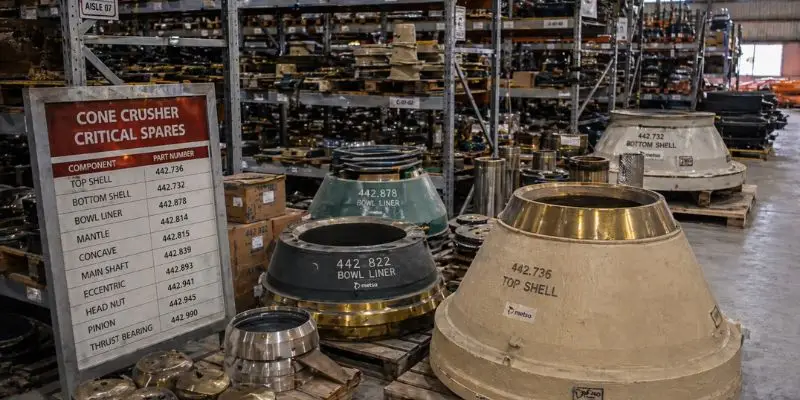
High probability, high consequence components should always be stocked on site. These are the parts most likely to require replacement within your planning horizon and most likely to cause extended downtime if they’re not immediately available. For most cone crusher configurations at large mining operations, mantles and bowl liners at various wear stages, critical hydraulic components, and seal assemblies fall into this category.
Low probability, high consequence components should be stocked at the supplier level with a clear and verified commitment on delivery time. These are the parts you hope never to need urgently but can’t afford to wait weeks for if you do. Main frames, heads, and major structural components typically fall here. The right answer isn’t to stock them on site, it’s to have a supplier who can get them to you faster than the standard lead time if the situation requires it.
High probability, low consequence components can be managed on a standard reorder cycle without urgent stocking requirements. These are parts that wear predictably, have multiple sources, and carry short lead times. If they run out, the operational impact is manageable while a replacement order arrives.
Low probability, low consequence components can be ordered on demand without any stocking requirement. These are parts that fail rarely, have short lead times, and don’t create significant downtime if a short delay occurs while the order is processed.
How to Build a Crusher Parts Inventory Around Risk Rather Than Habit
Most large mining operations have a parts inventory that evolved from habit rather than from deliberate risk assessment. Parts that were needed urgently once got added to the standing stock list. Parts that were never urgently needed never made the list, regardless of what their consequence would be if they were. Over time, that habit-based inventory accumulates significant misalignment between what’s stocked and what should be stocked.
Resetting that alignment requires going back to the risk framework rather than auditing the current stock list for obvious gaps. Start with your downtime records from the past two to three years and identify the five to ten events that created the most production impact. For each of those events, determine whether the downtime duration was extended by parts availability and what part was the critical path item.
That analysis typically reveals a small number of components that account for a disproportionate share of extended downtime events. Those components, if not already stocked, should be the first additions to your on-site inventory. The parts that are currently stocked but have never been the critical path item in a downtime event are candidates for moving to supplier-stocked or on-demand status, freeing up capital for the components that actually matter.
Managing Cone Crusher Spare Parts Across Multiple Machines and Wear Cycles
Large operations running multiple cone crushers face an additional planning complexity: the same component type may be at a different wear stage across different crushers simultaneously, and wear cycles across different crusher positions in the circuit may be meaningfully different depending on what each machine is processing.
A secondary crusher handling harder, more abrasive ore may go through liners significantly faster than a tertiary crusher handling the product of the secondary stage. Planning cone crusher spare parts inventory across those two machines as if they have the same wear cycle will consistently result in either overstocking for the slower machine or understocking for the faster one.
The solution is to build a wear cycle model for each crusher position separately rather than applying a single wear interval estimate across all machines. That model uses the actual historical wear rate data for each position, accounting for the feed material it’s processing and the operating conditions it runs under, to generate position-specific reorder points and stocking quantities. It’s more work to build initially, but it produces a significantly more accurate and efficient parts inventory than a one-size approach.
The Parts Planning Mistake That Creates the Most Expensive Downtime
Here’s the parts planning failure mode that creates the most expensive and most avoidable downtime at large mining operations: treating liner changes as scheduled events while treating liner-adjacent components as on-demand items.
A liner change is a scheduled, predictable event. The parts required to complete it, the liner itself, any seal components replaced as a matter of course, and any components inspected and potentially replaced during the shutdown window, are all knowable in advance. When those adjacent components aren’t staged and ready before the shutdown starts, what should be a four-hour planned event becomes a six or eight-hour event while someone figures out whether a marginal component needs replacing and whether the required parts are on site.
The mines that execute liner changes most efficiently have a complete kitting process: every part that might reasonably be needed during the liner change window is identified, checked for availability, and staged before the shutdown begins. That process doesn’t require stocking every possible component. It requires reviewing the machine’s condition in advance of the shutdown and confirming that anything with a reasonable probability of being needed is already on hand.
At large operations running multiple crushers, that kitting discipline applied consistently across all crusher positions is one of the highest-return improvements available to a maintenance planning team. It doesn’t reduce the number of parts consumed. It eliminates the downtime extensions that come from discovering mid-shutdown that a needed part isn’t on the shelf.
Building a Supplier Relationship That Supports Your Parts Strategy
A well-designed mining crusher parts strategy only works if your supplier can execute against it. That means your supplier needs to be doing more than processing orders. They need to be a genuine partner in the planning process.
Specifically, a supplier who supports a large operation’s parts strategy effectively should maintain stocked inventory of your critical components rather than manufacturing to order, provide reliable and verified lead time commitments for non-stocked items so your risk assessment is built on accurate data, communicate proactively when their inventory position on a critical component changes in a way that affects your risk profile, and be reachable directly when an urgent situation requires a rapid response rather than routing through layers of account management.
The supplier relationship is the infrastructure your parts strategy runs on. A strategy that’s well designed but dependent on a supplier who can’t execute against it will underperform consistently, regardless of how good the planning process is.
Cone crusher spare parts availability and mining crusher parts planning are two sides of the same problem, and the operations that handle both well have a genuine competitive advantage in their crushing circuit reliability. If your current parts planning process is more reactive than strategic, or if your supplier relationship isn’t giving you the support your planning process requires, Optimum Crush is built to be exactly the kind of parts and engineering partner large mining operations need. Reach out and let’s talk about how we can support your parts strategy.
FAQ
What cone crusher spare parts should a large mining operation always keep on site?
The components worth prioritizing for on-site inventory are those with the highest combination of failure probability within your planning horizon and production consequence if unavailable. For most large cone crusher configurations, that means mantles and bowl liners at various wear stages, critical hydraulic system components, seal assemblies, and any components with known wear rates that can be predicted from your operational data. A formal risk assessment that maps your historical downtime events against parts availability is the most reliable way to build this list for your specific machines and operating conditions.
How do I decide between stocking a cone crusher part on site versus relying on supplier stock?
Use the two-dimension framework: probability of needing the part within your planning horizon and consequence if it’s not available when needed. High probability and high consequence parts belong on site. High consequence but low probability parts belong in your supplier’s stock with a verified rapid delivery commitment. Low consequence parts on either dimension can be managed on demand. Applying that framework to your full parts list produces a more capital-efficient and operationally effective inventory than either blanket overstocking or purely on-demand sourcing.
How do wear cycles differ across crusher positions at a large mining operation?
Wear cycles vary significantly across crusher positions because each position in the circuit is processing different feed material at a different size and hardness. A primary or secondary crusher handling run-of-mine or coarsely crushed ore processes larger, harder feed and typically experiences faster liner wear than a tertiary crusher handling the product of the upstream stages. Planning cone crusher spare parts inventory with position-specific wear rate models rather than a single average interval produces a more accurate stocking strategy and reduces both overstock and emergency order frequency.
What should I expect from a mining crusher parts supplier in terms of inventory and lead time commitments?
A supplier genuinely equipped to support a large mining operation should maintain stocked inventory of your critical components and be able to provide verified, reliable lead time commitments for non-stocked items. They should communicate proactively when their inventory position on a critical component changes and be accessible directly when urgent situations require immediate response. Suppliers who manufacture to order without maintaining relevant stock, or who can’t provide specific lead time commitments for critical components, introduce supply chain risk that a well-designed parts strategy can’t fully compensate for.
 English
  Spanish
  French