



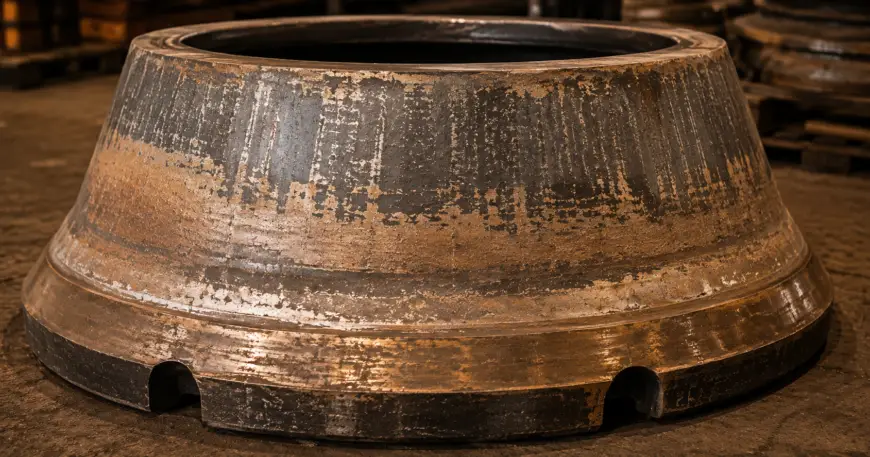
Waiting until mantles and bowl liners are visibly spent before replacing them feels like getting full value from the parts. In practice it frequently means paying for the last few weeks of a liner’s life in lost throughput and increased power cost rather than in wear parts spend.
Mantles and bowl liners don’t fail in a single event at the end of their life. They degrade progressively, and that degradation affects crusher performance well before the liner reaches the point where the maintenance team recognizes it needs to go. The teams consistently getting the most from their crushing circuits have learned to recognize the performance signals that precede the obvious visual wear indicators, and they make replacement decisions based on those signals rather than on appearance alone.
Why Liner Replacement Timing Is a Performance Decision, Not Just a Maintenance Decision
Liner replacement timing sits at the intersection of maintenance planning and production management, and treating it as purely a maintenance decision misses half of the equation. The moment a maintenance team decides to replace a liner determines not just the parts and labor cost of that change but the throughput, power efficiency, and product quality the crusher delivers from that moment until the next change.
Replace too late and the crushing circuit has been running below its performance potential for weeks, consuming more power per ton produced and delivering less consistent product than a fresher liner would have. Replace too early and usable liner life has been left on the table, adding unnecessary change frequency and associated downtime to the annual maintenance cost without a performance benefit that justifies it.
The optimal replacement point sits between those two errors, and finding it consistently requires understanding both what the liner looks like when it’s approaching that point and what the crusher’s operating data is saying about the performance impact of keeping it in service.
The Cost of Replacing Too Late Versus Too Early
Both timing errors have real costs, and understanding both is important for building a replacement framework that avoids each of them.
Replacing mantles and bowl liners too late costs more than most maintenance teams account for. A liner that’s past its optimal performance window delivers measurably lower throughput per shift, higher power draw per ton produced, and less consistent product gradation than one operating within its effective wear range. Those costs don’t appear on the wear parts invoice. They appear in the production report and the power bill, which is why they’re rarely connected back to liner replacement timing in the post-event analysis.
At large operations running high-tonnage cone crushers, the cumulative production loss from running a liner two or three weeks past its optimal replacement point frequently exceeds the cost of the liner change itself. The liner looked like it had life left. It did. But the performance it was delivering in those final weeks wasn’t worth what it was costing in throughput and power.
Replacing too early has a different and more straightforward cost: parts spend and downtime for a change that wasn’t necessary yet. This is the less common error but worth understanding because an overly conservative replacement trigger wastes capital and maintenance time that could have been directed elsewhere.
Six Signs It’s Time to Replace Your Mantles and Bowl Liners
1. Throughput Has Declined Without a Feed Condition Change
When tons per hour drops and nothing has changed in the feed rate, feed gradation, or CSS setting, the liner is the most likely explanation. A liner past its effective wear profile can no longer generate the compression efficiency it delivered earlier in its life, and the throughput decline is the measurable result. If the decline has been gradual over two or three weeks without a clear operational cause, the liner has probably crossed its optimal replacement point.
2. Power Draw Is Trending Up While Throughput Trends Down
This combination is one of the clearest performance signals that mantles and bowl liners are past their optimal operating window. The crusher is consuming more energy to produce less output because the chamber geometry has worn past the profile that converts energy into breakage efficiently. The liner is still physically serviceable. The performance math has already turned negative.
3. CSS Has Required More Frequent Adjustment Than Usual
Liner wear changes the effective CSS, and a liner approaching end of life typically requires more frequent CSS adjustment to maintain target gap than it did earlier in its life. If your team is adjusting CSS significantly more often than normal to hold product size and throughput targets, the liner’s wear rate has accelerated into the phase where the performance cost of keeping it in service is rising faster than the parts cost of replacing it.
4. Product Size Is Drifting Despite Correct CSS
When product gradation shifts toward coarser output and CSS is confirmed to be at the correct setting, the liner profile has worn past the geometry that produces the intended reduction ratio. The crusher is operating at the right gap but the worn liner profile is no longer generating the breakage pattern that CSS alone controls. Product size drift at correct CSS is a reliable indicator that the liner’s effective geometry has changed more than the physical wear measurement suggests.
5. Wear Measurements Show Acceleration in a Specific Zone
If your team is taking periodic wear measurements through the liner’s operating life, accelerating wear rate in a specific zone is a strong signal that replacement timing should be moved up. Accelerating wear in the lower chamber typically indicates the liner is past its designed wear range and the remaining material is being consumed faster than the average rate across the liner’s life suggested it would be. That acceleration rarely stabilizes. It typically continues until the liner is replaced or fails.
6. The Performance Improvement After a Liner Change Was Larger Than Expected
This one is retrospective but important for calibrating future timing decisions. If the throughput recovery and power draw improvement after your last liner change were significantly larger than expected, the previous liner was in service longer than it should have been. That data point tells you the optimal replacement threshold for your specific operation and ore conditions is earlier than your current timing framework assumed. Adjusting the trigger earlier on the next cycle captures that performance value before it’s lost.
How to Build a Replacement Timing Framework for Your Operation
A replacement timing framework that works consistently across liner cycles doesn’t require sophisticated monitoring infrastructure. It requires four data streams tracked routinely and reviewed together rather than separately.
Track throughput per shift and flag a sustained decline of more than five to eight percent from the liner’s peak performance as a replacement trigger review point. The specific threshold varies by operation, but establishing a site-specific number based on your historical data is more useful than applying a general guideline.
Track power draw per ton produced and flag a sustained increase that correlates with throughput decline rather than feed condition changes as a second trigger review point. Power and throughput moving in opposite directions is a reliable combined signal.
Maintain a CSS adjustment log and note when adjustment frequency increases relative to the earlier part of the liner cycle. Increased adjustment frequency is an early warning signal that precedes the more obvious throughput and power indicators.
Take periodic wear measurements at four to six points across the liner height at consistent intervals throughout the liner’s operating life, not just at removal. Building a wear progression curve from those measurements allows you to project when the liner will cross the replacement threshold rather than discovering it has already passed.
When two or more of those data streams are indicating that the replacement threshold is approaching, that’s the right time to schedule the change rather than waiting for a third or fourth signal to confirm what the first two already suggested.
The Performance Window Most Teams Are Missing
Here’s a pattern that shows up consistently at operations where liner replacement timing hasn’t been formally optimized: the performance window between peak liner performance and replacement threshold is significantly shorter than the total liner life, and most of the liner’s calendar life is spent either in the ramp-up phase after installation or in the declining performance phase after the optimal window has passed.
A liner that runs for ten weeks from installation to removal may deliver its best performance for weeks three through seven. Weeks one and two represent the ramp-up period as the liner seats and the chamber profile establishes itself. Weeks eight through ten represent the declining performance phase where throughput is down, power draw is up, and the crusher is operating below its potential while the liner is technically still in service.
The teams that optimize around this pattern target their replacement timing to capture the full performance window rather than the full physical life of the liner. They install the next liner at week seven or eight rather than week ten, accepting the loss of two or three weeks of physical liner life in exchange for eliminating two or three weeks of suboptimal production.
The economics of that trade depend on the specific operation, but for high-volume sites where the throughput loss in the declining performance phase exceeds the amortized cost of the liner over those final weeks, the math consistently favors earlier replacement. Mantles and bowl liners that are replaced at the right time deliver more value across their installed life than ones that run until they’re visually spent, even though the second approach uses more of the physical material.
If your team’s current liner replacement timing is based primarily on visual inspection and physical wear rather than performance data, there’s a good chance the optimal replacement point is arriving earlier than the current trigger recognizes. Optimum Crush’s engineering team helps operations build performance-based liner replacement frameworks that recover that window. Reach out and let’s look at what your operating data is telling you about where your optimal replacement point actually is.
 English
  Spanish
  French