
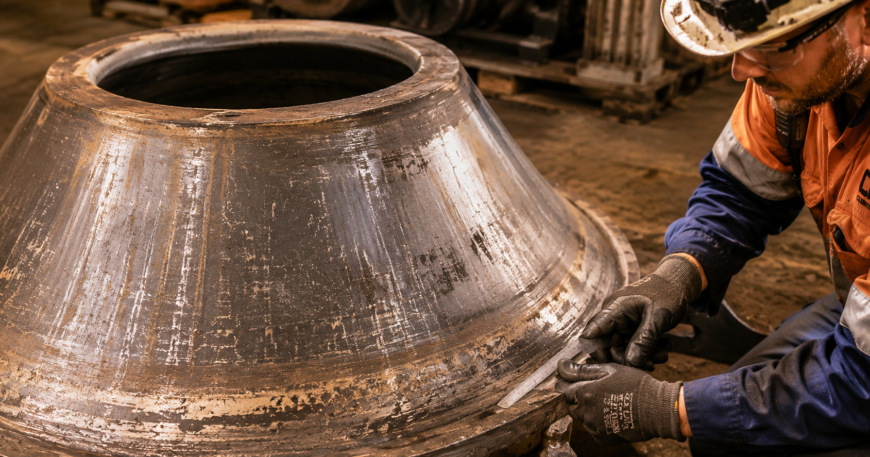
The performance your cone crusher wear parts deliver isn’t determined entirely by the parts themselves. A significant portion of it depends on how well your maintenance team understands them, and that’s a variable most operations underinvest in.
Cone crusher wear parts are the components your team interacts with most frequently across the maintenance cycle. They’re installed, monitored, and replaced more often than any other major component on the machine. That frequency creates the impression that the team knows them well. What it actually creates is familiarity with the procedure, which is different from understanding the engineering principles that determine whether the procedure yields optimal or merely acceptable results.
Why Wear Parts Knowledge Is a Performance Variable, Not Just a Maintenance Skill
The way a maintenance team handles cone crusher wear parts across their full life cycle, from installation through monitoring to removal and assessment, directly affects the performance those parts deliver. That’s true at every stage of the cycle, and the impact compounds across each one.
At installation, a team that understands how liner seating affects contact stress distribution will consistently achieve better seating quality than one following a procedure without understanding why each step matters. Better seating means more even load distribution, which means more even wear, which means longer effective liner life before performance begins to degrade.
During the operating cycle, a team that understands the relationship between CSS drift and liner wear will monitor and adjust more proactively than one that checks CSS only at scheduled intervals. That proactive management keeps the crusher operating closer to its optimal parameters throughout the liner’s life, which improves throughput consistency and reduces the power draw per ton produced.
At removal, a team that understands what wear patterns mean can extract diagnostic information from a pulled liner that improves the next liner selection decision. A team that treats liner removal as a parts swap rather than a data collection opportunity loses that information and resets the same suboptimal conditions on the next cycle.
Across all three stages, the knowledge gap between a team that understands the engineering behind their cone crusher wear parts and one that knows only the procedure translates directly into measurable performance differences. That’s why wear parts knowledge is a performance variable rather than just a maintenance skill.
The Knowledge Gaps That Cost the Most in Wear Parts Performance
Not all knowledge gaps are equally costly. Four gaps consistently have the greatest impact on the performance of cone crusher wear parts in mining operations.
The first is insufficient understanding of liner seating and backing material requirements. Improper liner seating is one of the most common causes of accelerated wear and uneven load distribution, and it’s almost entirely preventable with proper training on why correct seating matters and how to verify it. Teams that understand the consequences of poor seating take the installation process more seriously and catch seating problems before they become wear problems.
The second is limited understanding of the relationship between feed conditions and wear rate. Most maintenance teams know that feed conditions affect crusher performance. Fewer understand how surge feeding, feed segregation, and inconsistent choke feeding lead to accelerated liner wear and uneven wear distribution. That understanding changes how the team monitors and reports feed condition issues rather than accepting them as normal operational variability.
The third is inadequate wear measurement practice at liner removal. Many maintenance teams record whether a liner is worn out rather than how it wore and where the wear concentrated. That qualitative assessment throws away the diagnostic information that quantitative wear measurement at multiple points across the liner height would provide. Training teams to measure accurately and record consistently turns every liner removal into a data-collection event that improves the next liner decision.
The fourth is limited understanding of CSS management across the liner life cycle. Teams that understand how liner wear changes the effective CSS and why adjusting to compensate matters for both throughput and power efficiency manage CSS more actively throughout the liner interval. Teams without that understanding tend to set CSS at liner installation and revisit it only at scheduled intervals, which allows drift that affects both performance and liner life to go unaddressed between checks.
What Effective Cone Crusher Wear Parts Training Actually Covers
Effective training on cone crusher wear parts goes beyond procedure documentation. It builds understanding of why each procedure step matters, what happens when it’s done incorrectly, and how the team’s actions across the wear parts life cycle connect to the crusher performance outcomes the operation depends on.
The installation module should cover liner seating principles and how to verify correct seating, backing material selection and application, torque requirements and why they matter for liner retention, and the most common installation errors and their consequences. A team that completes installation training with genuine understanding of these principles produces consistently better installation quality than one that’s been shown the steps without the engineering rationale.
The monitoring module should cover CSS measurement and adjustment practices across the full liner life cycle, feed condition monitoring and what specific feed conditions to watch for and report, power draw interpretation and what changes in power draw indicate about crusher loading and liner condition, and product size monitoring as a proxy for liner wear progression and chamber geometry change.
The wear assessment module should cover quantitative wear measurement techniques, how to read and interpret wear patterns at liner removal, the connection between specific wear patterns and specific operating conditions or design issues, and how to document and communicate wear data in a way that supports better liner selection decisions going forward.
The crusher performance optimization module should connect all of the above to the crusher’s overall performance metrics, helping the team understand how their actions across the wear parts life cycle affect throughput, power efficiency, product quality, and liner interval length simultaneously rather than as separate outcomes.
How Better Knowledge Translates Into Measurable Crusher Performance Gains
The performance gains from better wear parts training show up across four measurable dimensions that operations managers and maintenance leads can track directly.
Liner life improvement is typically the first and most visible gain. Teams that seat liners correctly, manage CSS proactively, and monitor feed conditions consistently extend liner intervals compared to teams following procedures without engineering understanding. The improvement varies by how significant the current knowledge gap is, but gains of 10 to 25 percent in liner life from training alone, without any change in liner specification, are achievable at sites where current practice has meaningful gaps.
Throughput consistency improvement follows from better CSS management and feed condition monitoring. A team that maintains tighter CSS control throughout the liner interval and catches feed condition problems earlier delivers more consistent throughput per shift than one that allows drift and variability to compound unchecked.
Reduction in unplanned downtime events results from the combination of better installation quality, more proactive monitoring, and better early identification of developing wear issues through improved wear assessment practice. Each of those changes individually reduces unplanned event frequency. Together they create a maintenance approach that’s meaningfully more proactive than the procedure-only baseline.
Crusher performance optimization at the system level becomes possible when the maintenance team’s knowledge base is strong enough to participate in engineering conversations about liner selection, operating parameter adjustments, and performance improvement decisions rather than simply executing decisions made elsewhere. That participation improves decision quality and builds the team’s ownership of crusher performance outcomes in a way that procedure-only training doesn’t.
The Training Topic Most Programs Skip That Has the Biggest Impact
Here’s the training topic that gets the least coverage in standard wear parts training programs and consistently has the highest impact when it’s included: the connection between liner wear progression and real-time crusher behavior.
Most training programs teach teams to assess liner condition at removal. Very few teach them to read the crusher’s real-time operating signals, power draw changes, CSS drift rate, throughput variation, and product size shift, as indicators of where the liner is in its wear progression. That real-time reading capability is what allows a team to manage the liner actively throughout its life rather than reacting to it at change time.
A maintenance team that can look at power draw trending upward over three shifts alongside a gradual throughput decline and recognize that the liner is entering the back half of its performance curve, where proactive CSS adjustment will recover throughput before it becomes a problem, is operating at a fundamentally higher level than one that runs the same data without connecting it to liner wear progression.
Teaching that connection, between real-time operating signals and liner wear stage, is the training investment that unlocks the most crusher performance optimization value from an existing team. It doesn’t require new parts, new equipment, or new procedures. It requires understanding that the team didn’t previously have, and that understanding changes how they interact with the crusher every shift it runs.
Building a Wear Parts Knowledge Culture on Your Maintenance Team
Training events build knowledge. Knowledge culture sustains it. The difference between a maintenance team that improves after a training engagement and one that reverts to previous practices within a few months is usually whether the knowledge becomes part of how the team operates day-to-day rather than something they remember from a training session.
Building that culture requires a few specific practices alongside the training itself. Standardized wear measurement and documentation at every liner removal, so data collection becomes routine rather than exceptional. Regular brief reviews of wear data and operating parameter trends with the team, so the connection between what they’re monitoring and what it means for crusher performance stays active rather than fading after the training. And access to engineering support that reinforces the training content in real operational contexts, so questions that arise during a shift can be answered by someone who can connect the answer back to the principles rather than just the procedure.
Cone crusher wear parts training that builds genuine understanding rather than just procedure familiarity, and that’s reinforced by the right support relationship, is one of the highest-return investments a mining operation can make in its crushing circuit performance. If your team’s current wear parts knowledge has gaps that are costing you liner life or crusher performance optimization, Optimum Crush offers both on-site and virtual training built around exactly these principles. Reach out and let’s talk about what a training engagement could look like for your operation.
 French
  English
  Spanish