



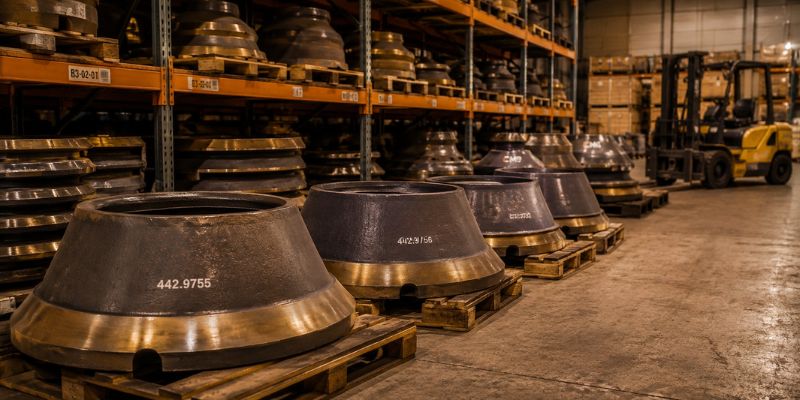
When a cone crusher goes down unexpectedly, the clock starts immediately. Whether that clock runs for four hours or four days often has less to do with the severity of the problem than with whether the right cone crusher spare parts were already on a shelf somewhere accessible.
That reality makes parts availability one of the most controllable variables in unplanned downtime management, and one of the most consistently underinvested ones. Most large mining operations have significant engineering and maintenance capability on site. Many have sophisticated monitoring and diagnostic systems. Fewer have a parts availability strategy that matches the capability of everything else they’ve invested in, and the gap shows up every time an emergency event extends because the right part is three days away.
Why Parts Availability Is a Downtime Variable, Not Just a Procurement Variable
The way most mining operations manage cone crusher spare parts, as a procurement function focused on unit cost and lead time, reflects an incomplete understanding of what parts availability actually affects. Parts availability is a downtime variable. It directly determines how long the crusher stays down after an unplanned event, which means it directly determines how much that event costs in lost production.
The math is straightforward. An unplanned event that takes two hours to diagnose and one hour to repair if the part is on site takes two hours to diagnose and seventy-two hours to repair if the part has to be ordered and shipped. The diagnosis time is identical. The repair time is identical once the part arrives. The difference, seventy-one additional hours of downtime, is entirely attributable to parts availability rather than to the severity of the mechanical problem.
At large mining operations where downtime cost is measured in tens of thousands of dollars per hour, seventy-one hours of avoidable downtime represents a parts investment that would have paid for itself many times over at the first emergency event it prevented. That calculation is why parts availability belongs in the operations and maintenance conversation rather than only in the procurement conversation.
The Difference Between a Parts Inventory and a Parts Strategy
Most mining operations have a parts inventory. Fewer have a parts strategy. The distinction is important because an inventory that evolved without a deliberate strategy frequently has the wrong composition: overstocked on low-consequence items that were ordered once and never used, and understocked on high-consequence items that weren’t prioritized until an emergency revealed the gap.
A parts strategy is built around a deliberate assessment of which components are most likely to create extended downtime if they’re unavailable when needed. That assessment accounts for four variables: the probability that the component will require unplanned replacement within a defined time horizon, the consequence of extended downtime if it isn’t immediately available, the lead time from any supplier under both standard and emergency conditions, and the cost of stocking the component on site relative to the downtime cost it prevents.
Components that score high on probability and consequence and have long lead times are the foundation of an effective on-site cone crusher spare parts strategy. Components that score low on both dimensions, or that have very short lead times from a reliable supplier, are candidates for supplier-stocked or on-demand management rather than on-site inventory.
Building a strategy around those four variables produces a fundamentally different and more effective inventory composition than one that evolved from habit, historical orders, and reactive additions after emergency events.
Which Cone Crusher Spare Parts Are Worth Stocking On Site
The specific components worth prioritizing for on-site inventory vary by crusher model, operating conditions, and site location, but a consistent framework applies across most large cone crusher operations.
Mantles and bowl liners at various wear stages are the highest-priority on-site stock item for most operations. They’re the most frequently replaced components on the machine, their lead time from most suppliers runs weeks rather than days, and having the next liner set staged and ready before the current one reaches end of life eliminates the downtime gap that occurs when a liner change can’t proceed because the replacement hasn’t arrived. Many operations benefit from keeping not just the next planned liner set but a full backup set as well, particularly at remote sites where supply chain disruptions are more likely.
Critical hydraulic components including seals, o-rings, and any components with known wear rates in the hydraulic system warrant on-site stocking at most operations. Hydraulic system failures are among the more common causes of unplanned cone crusher downtime, and many of the components involved are small, relatively inexpensive, and have lead times that extend downtime significantly if they’re not immediately available.
Lubrication system components including filter elements, temperature sensors, and flow monitoring components are worth maintaining on site. Lubrication system faults are a common cause of crusher shutdowns, and the components involved are typically low-cost relative to the downtime they prevent when immediately available.
Crusher-specific wear components with documented wear rates based on your operating history should be stocked based on your actual consumption rate rather than a general recommendation. If your operating data shows that a specific component requires replacement every three to four months, stocking a replacement on site as that interval approaches is straightforward risk management.
How Supplier Inventory Complements Your On-Site Stock
On-site inventory and supplier inventory serve different but complementary roles in a complete cone crusher spare parts strategy. On-site inventory covers the components most likely to be needed urgently and most consequential if unavailable. Supplier inventory covers the components that are too large, too expensive, or too infrequently needed to justify on-site stocking but still need to be accessible faster than standard manufacturing lead times allow.
The supplier inventory relationship only delivers value if it’s built on a verified and reliable commitment rather than an assumption. A supplier who claims to stock critical components but can’t provide a specific, committed delivery time under emergency conditions isn’t providing the inventory backup your strategy is counting on. Verifying what your supplier actually has in stock, and what their realistic delivery commitment is for your site location under emergency conditions, is an essential part of building a complete parts availability strategy rather than just an on-site inventory.
Suppliers who maintain genuine stocked inventory of the parts most critical to your specific crusher model and configuration, and who can ship same day when an emergency order comes in, are providing a fundamentally different service than suppliers who manufacture to order or who maintain only limited inventory of common items. That difference is worth understanding and confirming before an emergency tests it.
The Parts Availability Gap Most Operations Don’t Discover Until It’s Too Late
Here’s the parts availability gap that creates the most expensive and most avoidable downtime extensions at large mining operations: the assumption that emergency parts availability is someone else’s responsibility to figure out when the emergency happens.
At many operations, the parts strategy conversation stops at the on-site inventory. What happens when the on-site inventory doesn’t have what’s needed is treated as a logistics problem to solve in the moment rather than a risk to manage in advance. The result is that emergency logistics, including identifying suppliers, confirming availability, arranging expedited shipping, and navigating customs if the site is in a jurisdiction requiring import documentation, all happen under time pressure while the crusher is already down.
Every hour spent on emergency logistics that could have been pre-arranged is an hour of avoidable downtime. The operations that manage this well don’t just maintain on-site inventory. They also maintain pre-arranged emergency supply relationships with verified delivery commitments, pre-completed supplier qualification documentation for customs purposes at remote or international sites, and a clear escalation process that starts those logistics immediately when an on-site inventory gap is identified rather than after a delay while the team figures out who to call.
Reducing crusher downtime in emergency parts situations isn’t primarily about having more parts on site. It’s about eliminating the decision-making and logistics delays that extend the time between identifying a parts gap and getting the right part to the machine. Pre-arranging those logistics before the emergency is what separates operations that resolve parts-limited downtime events in hours from those that resolve them in days.
Building a Spare Parts Strategy That Holds Under Emergency Conditions
A cone crusher spare parts strategy that holds under emergency conditions has four components working together rather than any single element working in isolation.
On-site inventory built around the risk framework: the right components stocked in the right quantities based on failure probability, consequence, and lead time rather than habit or historical order patterns.
Verified supplier inventory with confirmed delivery commitments: a supplier relationship where on-hand stock levels for your critical components and delivery times to your site under emergency conditions are known and confirmed rather than assumed.
Pre-arranged emergency logistics: customs documentation, expedited shipping accounts, and escalation contacts identified and ready to activate before they’re needed rather than being assembled under pressure during an active downtime event.
A clear internal process for activating the strategy when an unplanned event occurs: who identifies the parts gap, who contacts the supplier, who arranges logistics, and what the escalation path is if the primary supply option isn’t available. That process, documented and practiced rather than improvised in the moment, is what ensures the strategy actually executes under the pressure of a real emergency.
Cone crusher spare parts availability and the ability to reduce crusher downtime when something unexpected happens are directly connected, and the operations that manage that connection deliberately rather than reactively have a measurable advantage in how they handle the unplanned events that every mining operation eventually experiences. If your current spare parts strategy has gaps or hasn’t been formally assessed against the risk framework, Optimum Crush can help you work through it. Reach out and let’s build a parts availability approach that holds up when it matters most.
FAQ
Which cone crusher spare parts should always be kept on site at a large mining operation? The components that consistently warrant on-site stocking are those with the highest combination of failure probability within your planning horizon and production consequence if unavailable. For most large cone crusher configurations, that means mantles and bowl liners at various wear stages, critical hydraulic system components including seals and o-rings, lubrication system components including filter elements and sensors, and any components with documented wear rates from your operating history that approach replacement intervals within your planning horizon. A formal risk assessment that maps your historical downtime events against parts availability gaps is the most reliable way to build a site-specific list.
How do I calculate whether stocking a cone crusher spare part on site is worth the investment? Compare the cost of stocking the part against the cost of the downtime it would prevent in the scenario where it’s needed but not available. Start with your site’s downtime cost per hour, multiply it by the realistic lead time for the part under emergency conditions, and that’s the maximum downtime cost the part would prevent in the worst case. If that number is significantly larger than the carrying cost of the part, stocking it is economically justified. For high-consequence, long-lead-time components at operations with significant downtime costs per hour, the math almost always favors stocking.
What’s the difference between on-site spare parts inventory and supplier-stocked inventory, and when does each apply? On-site inventory covers components most likely to be needed urgently and most consequential if the machine can’t run while waiting for them. Supplier-stocked inventory covers components too large, expensive, or infrequently needed to justify on-site stocking, but which still need to be accessible faster than standard manufacturing lead times. The two approaches work together in a complete strategy: on-site inventory for the highest-consequence items and verified supplier stock with confirmed rapid delivery for the next tier of critical components.
How do I verify that my parts supplier actually has critical cone crusher spare parts in stock? Ask directly and specifically. Request confirmation of current stock levels for the specific components critical to your crusher model and configuration, and ask for their committed delivery time to your site location under emergency conditions rather than standard lead time. A supplier with genuine stocked inventory can answer those questions with specific numbers. One who manufactures to order or maintains limited inventory will give vague or hedged answers. Verifying this before an emergency tests it is worth the conversation.
 English
  Spanish
  French