



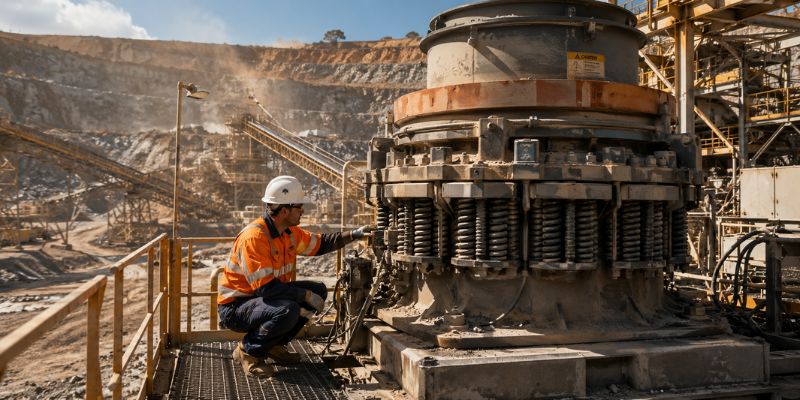
Remote crusher support resolves a lot of problems. The ones it can’t resolve have something in common: they require someone to actually look at the machine, put their hands on the components, and make a judgment call that a phone call can’t replicate.
Knowing when that threshold has been crossed is one of the more valuable operational judgments a mine maintenance team can develop. Called too late, on-site cone crusher engineering support arrives after a problem has compounded beyond what earlier intervention would have cost. Called at the right time, it resolves situations that remote troubleshooting has been circling without closing and prevents the kind of escalation that turns a manageable problem into a major production event.
The Difference Between Problems Remote Support Can Solve and Problems It Can’t
Remote crusher support works well for a defined category of problems: those where the diagnosis can be made from operational data, the corrective action is an operating parameter adjustment or a scheduled parts change, and the information required to give specific guidance is available without physical access to the machine.
CSS recalibration guidance, liner change timing recommendations, feed condition adjustments, hydraulic system parameter checks, and operating parameter optimization are all situations where a knowledgeable engineer can provide genuinely useful guidance remotely, provided they have access to the relevant operational data.
The situations remote support handles poorly are those where the diagnosis requires physical observation or measurement that operational data can’t substitute for. Unusual wear patterns that need to be measured and mapped across the liner surface. Mechanical noises or vibrations that need to be heard and felt in context to be correctly characterized. Structural conditions that need to be visually inspected to assess severity. Assembly or installation situations where dimensional verification requires physical measurement rather than specification reference.
Those situations share a common characteristic: the information required to make a good decision exists at the machine, not in a data system. Remote support can interpret data. It can’t substitute for physical presence when physical presence is what the diagnosis requires.
Five Situations That Warrant On-Site Cone Crusher Engineering Support
1. A Recurring Problem That Remote Troubleshooting Has Failed to Resolve
If your maintenance team and your remote support contact have been working on the same problem through multiple cycles without closing it, the root cause almost certainly requires physical investigation to identify. The information needed to find it is at the machine, and continuing to troubleshoot remotely without that information is unlikely to produce a different result. This is the clearest and most common indicator that on-site cone crusher engineering support is the right next step.
2. Unusual Mechanical Symptoms With No Clear Data Explanation
Unusual noises, vibration patterns, or mechanical behavior that doesn’t correlate with anything obvious in the operational data requires physical presence to characterize correctly. An experienced engineer who can hear and feel the machine under load has access to diagnostic information that no data system captures. For mechanical symptoms that don’t fit a known pattern, on-site assessment is frequently the fastest path to a correct diagnosis.
3. A Major Liner Change or Rebuild With Performance Implications
Scheduled major maintenance events, particularly liner changes where the profile or alloy is being changed based on a wear analysis, benefit significantly from on-site engineering involvement. Having an engineer present to verify the installation, take wear measurements at removal, and assess the machine’s overall condition while it’s accessible gives the maintenance team information and decisions that a remote follow-up after the fact can’t fully replicate.
4. A New Operation or Significant Change in Operating Conditions
When a crusher is starting up for the first time, being returned to service after a major rebuild, or being run on significantly different feed material than it was previously optimized for, on-site engineering support during the initial operating period helps identify and address issues before they become established problems. The cost of early on-site involvement is almost always lower than the cost of correcting optimization decisions that were made without adequate engineering input during the critical early operating period.
5. A High-Consequence Situation Where Getting It Wrong Is Not an Option
Some maintenance decisions carry consequences significant enough that the risk of a remote diagnosis being incomplete is too high to accept. A crusher that’s the sole machine in a critical circuit position, a site where the next scheduled maintenance window is months away, or a situation where an incorrect repair approach could cause secondary damage all represent cases where the additional certainty that on-site engineering presence provides is worth the cost and logistics of arranging it.
What a Productive On-Site Engineering Visit Actually Looks Like
A productive on-site cone crusher engineering support visit has a clear structure that separates it from a site visit that generates a report without producing resolution.
It starts before the engineer arrives. A productive visit requires that the maintenance team has assembled the relevant operational data, identified the specific questions they need answered, and prepared the machine or site conditions to allow the assessment to happen efficiently. An engineer who arrives to a site without operational data and without a clear scope of what needs to be assessed spends a significant portion of the visit reconstructing context that should have been available from the start.
The visit itself should cover a physical machine assessment that goes beyond the specific presenting problem to evaluate the overall condition of the machine. Problems that weren’t the stated reason for the visit are frequently identified during a thorough physical assessment, and identifying them while an engineer is already on site is significantly more efficient than scheduling a separate visit later.
The visit should end with specific, prioritized recommendations rather than a general condition report. The maintenance team should leave the visit knowing exactly what needs to be done, in what order, and with what urgency, with the engineering rationale for each recommendation clearly understood rather than just documented.
How to Prepare Your Site to Get the Most From an Engineering Visit
The quality of outcome from an on-site mining crusher service support visit is directly affected by how well the site is prepared before the engineer arrives. Four preparation steps consistently make the difference between a visit that resolves the problem and one that identifies it without fully closing it.
Assemble the operational data the engineer will need: wear measurements from recent liner removals, power draw history across the current liner cycle, CSS records, feed gradation data if available, and a clear account of when the presenting problem first appeared and what has changed in the operating conditions since.
Prepare access to the machine in the condition most relevant to the assessment. If the problem occurs under load, the engineer needs to observe the machine running. If the problem is visible at rest, the machine needs to be safely isolated and accessible for physical inspection. Arranging the right access condition in advance avoids the situation where the visit window is partially consumed by access preparation.
Identify the specific questions that need to be answered by the end of the visit. A visit with a clear outcome scope is significantly more productive than one where the scope expands reactively as the assessment progresses.
Have the maintenance team members most familiar with the machine’s recent behavior available and present during the visit. Their direct knowledge of how the machine has been operating and what has changed is often the most valuable contextual input an engineer receives during an on-site assessment.
Why the Best Time to Arrange On-Site Support Isn’t During a Crisis
Here’s a perspective that experienced crusher engineers hold consistently: the on-site visit that delivers the most value isn’t the emergency visit arranged in response to a crisis. It’s the planned periodic visit arranged as part of a proactive support relationship.
Emergency on-site visits happen under time pressure, with limited preparation, and with the maintenance team’s attention divided between the immediate problem and ongoing operational demands. The conditions for a thorough, systematic assessment are rarely present during a crisis, which means emergency visits frequently resolve the immediate situation without addressing the underlying conditions that created it.
Planned periodic visits happen under conditions that allow thorough assessment, complete data review, and systematic evaluation of the machine’s overall health rather than just its current presenting problem. They identify developing issues before they become crises, build the engineering partner’s knowledge of the specific machine and site, and produce recommendations that are better informed and more comprehensive than what emergency visits typically deliver.
The mining operations that get the most value from on-site cone crusher engineering support are the ones that treat it as a planned component of their maintenance program rather than a last resort when remote support has run out of options. Building that relationship before a crisis occurs means that when a crisis does occur, the engineer who responds already knows the machine, the site, and the operating conditions rather than starting from scratch under pressure.
What to Expect in Terms of Outcomes
A well-executed on-site cone crusher engineering support visit should produce four specific outcomes that the maintenance team can act on immediately and reference going forward.
A root cause determination for the presenting problem, with a clear explanation of what’s causing the symptom rather than just what the symptom is. A prioritized recommendation list that distinguishes between what needs to be addressed immediately, what should be addressed at the next scheduled maintenance window, and what should be monitored but doesn’t require intervention yet. A machine condition baseline that documents the current state of the key components and systems assessed during the visit, which serves as a reference point for future assessments. And a data collection recommendation that identifies what additional information the site should be capturing between visits to support better remote troubleshooting and proactive issue identification going forward.
If your current support model doesn’t include on-site engineering involvement as a genuine option, or if on-site visits from your current supplier don’t produce those four outcomes, the support relationship isn’t delivering what a mining operation at your scale deserves. Optimum Crush’s engineering team provides on-site cone crusher engineering support as a core part of our service model, not as an exceptional accommodation. Reach out and let’s talk about what on-site support could look like for your operation and your specific situation.
 French
  English
  Spanish