

Your chamber design might be costing you tons every shift, and your crusher won’t tell you directly. It’ll just keep running, a little slower and a little harder, until a liner change comes around and nothing really improves.
That’s the pattern crusher liner optimization is built to break. When the chamber profile doesn’t match your feed material, your operating conditions, or your production targets, the losses show up in ways that are easy to misread. Here’s what to watch for.
Why Chamber Design Has a Bigger Impact Than Most Teams Expect
The cone crusher’s chamber is where feed material is actually broken down, and the liner profile controls how that breakage happens. A profile that’s even slightly mismatched to your feed gradation or reduction ratio will affect throughput, product size consistency, power draw, and wear life simultaneously.
Most teams don’t connect those symptoms back to chamber design because each one, on its own, looks like a different problem. Throughput looks like a feed issue. Product size looks like a CSS issue. Wear looks like a material hardness issue. When they all show up together, the real cause is often the liner profile itself.
The 7 Warning Signs
1. Throughput Is Consistently Below Target
If you’re running at the right CSS and feeding the crusher correctly but still not hitting your tonnage targets, the chamber profile may not be suited to your feed. A liner designed for a coarser feed will underperform when run on finer material, and vice versa.
2. Uneven Wear Across the Liner Surface
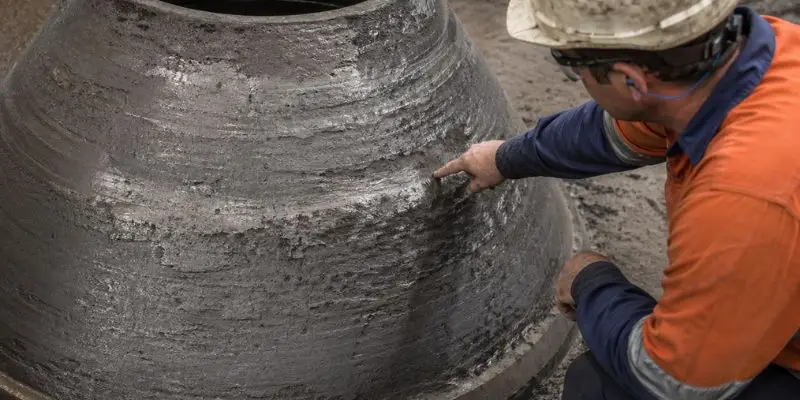
Even wear from top to bottom is the goal. If you’re seeing heavy wear concentrated in one zone of the mantle or bowl liner, the chamber isn’t loading the material evenly. That points to a profile mismatch, a feed distribution problem, or both.
3. Product Size Is Drifting Without a CSS Change
When your product gradation shifts and your CSS hasn’t moved, the chamber is telling you something. It usually means the liner has worn past its effective profile and the nip angle has changed enough to affect how material is being broken.
4. Power Draw Is High but Throughput Is Low
This combination is one of the clearest signals of poor crusher liner optimization. The machine is working hard, but the chamber geometry isn’t converting that energy into production efficiently. Often the liner profile is creating too much compression without enough progression through the chamber.
5. You’re Replacing Liners More Frequently Than Expected
Accelerated wear almost always has a cause. If your liners aren’t reaching their expected life, the chamber design may be creating localized stress points rather than distributing wear evenly across the surface. That’s an engineering problem, not just a materials problem.
6. Crusher Is Frequently Overloading or Packing
Packing, where material stalls in the chamber and the crusher bogs down, is a sign that the chamber geometry isn’t moving material through efficiently. It’s often caused by a liner profile with too tight a choke zone for the feed gradation being processed.
7. Performance Improves Dramatically With a New Liner, Then Drops Off Quickly
If you see a sharp performance spike after a liner change that fades faster than it should, the new liner isn’t matched to your conditions either. You’re not solving the problem, you’re resetting it. That cycle is worth breaking with a proper crusher liner optimization review before the next change.
Most Teams Are Solving the Wrong Problem
Here’s a pattern we see repeatedly: a mine identifies that liner life is short and responds by sourcing a harder alloy. The new liner lasts longer, but throughput stays flat or gets worse because the underlying profile was never evaluated.
Alloy hardness and liner profile are two separate variables. A harder liner in the wrong profile will outlast a softer one but still underperform on tons. The right approach is to solve the profile problem first, then optimize the alloy. Crusher liner optimization done in the right order saves both part cost and lost production. Done in the wrong order, it just changes which variable you’re overspending on.
What to Do If You’re Seeing These Signs
If two or more of these warning signs are showing up consistently, a liner profile review is worth prioritizing before your next scheduled change. The data you need is already on your site: wear measurements, power draw history, product size records, and feed gradation. With that information, an engineering review can identify whether a profile adjustment, an alloy change, or an operating parameter correction will have the most impact.
Good crusher liner optimization doesn’t always mean a major redesign. Sometimes it means a targeted adjustment that changes the performance curve significantly. The goal is always to get more tons through the machine with less wear and fewer interventions, and that starts with an honest look at what the chamber is actually doing.
If any of these warning signs sound familiar, Optimum Crush’s engineering team can help you work through the data and find the right fix. Get in touch and let’s figure out what your chamber is telling you.
FAQ
How do I know if my cone crusher liner profile is wrong for my application? The clearest indicators are uneven wear patterns, throughput that’s consistently below target despite correct CSS and feed, and product size that drifts without any operating changes. A site-specific liner analysis using wear measurements and production data can confirm whether your current profile matches your feed gradation and reduction ratio requirements.
Can crusher liner optimization improve wear life and throughput at the same time? Yes, and that’s actually the goal. When the liner profile is properly matched to your feed and operating conditions, the chamber loads more evenly, wear distributes more consistently across the surface, and throughput improves because the crusher is converting energy into breakage more efficiently. The two outcomes reinforce each other when the profile is right.
What’s the difference between a liner alloy upgrade and a liner profile change? A liner alloy upgrade changes the material hardness and wear resistance of the liner. A profile change alters the geometry of the crushing chamber itself. Both affect performance, but they solve different problems. If throughput is the issue, profile is usually the more important variable. If wear life is the issue, alloy matters more. The best results come from evaluating both together.
How often should chamber design be reviewed for a cone crusher? At minimum, it’s worth reviewing chamber design whenever you’re seeing consistent performance gaps, after any significant change in feed material characteristics, and when you’re planning a liner change following an unusually short liner life. High-production sites benefit from a formal review annually even when performance looks stable.
 French
  English
  Spanish